Trading guide
Candlestick patterns with exact rules.
"Doji", "pin bar" and "inside bar" sound precise, but almost every book and video measures them differently. This guide gives one set of written numbers for five common candle shapes, so the same chart gets the same labels every time.
By Rana Usman · 19 November 2026 · 5 min read · Educational, not financial advice.
The rules
Five shapes, five written rules.
Each rule uses only the open, high, low and close of the candle and, where needed, the previous candle. Decide on a closed candle only, so a label cannot appear and then disappear.
| Doji | The body (open to close) is at most 10% of the candle's whole range (high to low). Open and close are almost the same. |
|---|---|
| Long wick (pin bar) | One wick is at least 2 times the body AND at least 60% of the range, and the other wick is at most 20% of the range. If both wicks qualify, it is not a long-wick candle. |
| Inside candle | Its high is not above the previous high, its low is not below the previous low, and its range is smaller than the previous candle's range. |
| Outside candle | Its high is above the previous high AND its low is below the previous low. |
| Engulfing | Its body covers the whole body of the previous candle, is bigger than that body, and the two candles closed in opposite directions (one up-close, one down-close). |
| Too small to count | Candles whose range is less than half of the 14-candle average true range (ATR) are skipped, so tiny candles on quiet charts are not labelled. |
On a real chart
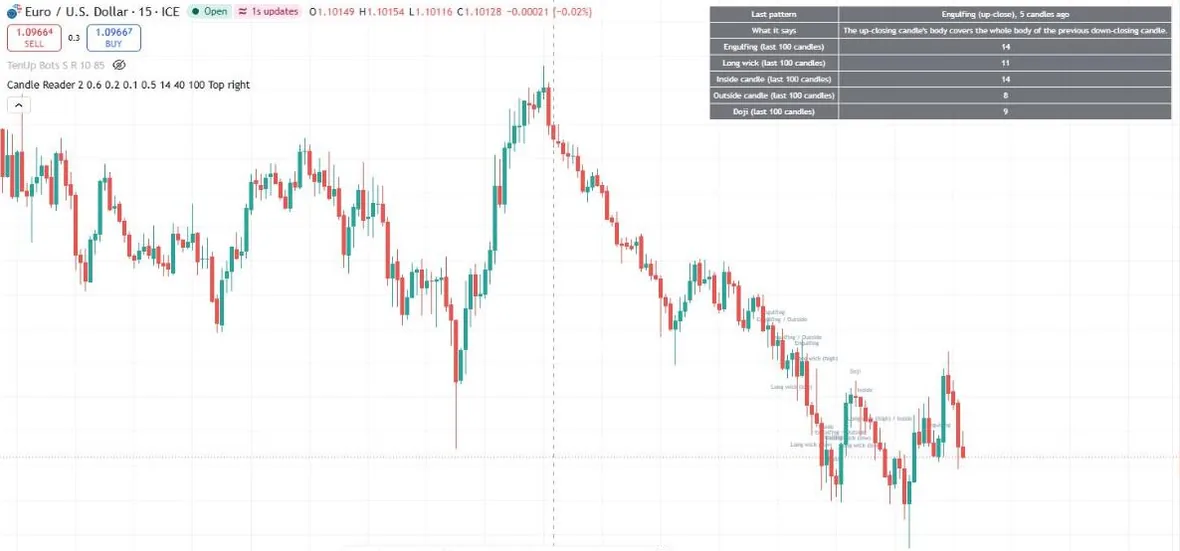
How often the shapes appear.
Common mistakes
Why two people disagree.
- Judging the wick by eye instead of comparing it with the body and the range.
- Calling a candle "engulfing" when only the wicks cover the previous candle, not the body.
- Labelling tiny candles on a quiet chart, where almost everything looks like a doji.
- Labelling the candle that is still forming; its shape can change until it closes.
Limits
What a shape does not tell you.
- A shape describes one or two candles. It does not say what price will do next.
- Different brokers print slightly different candles, so counts differ a little between platforms.
- Nothing here is a trading signal or financial advice. Trading is risky and you can lose money.
Questions
Short answers.
Why use numbers instead of judging candles by eye?
Because people judge the same candle differently. With written numbers, two traders looking at the same chart label the same candles, and you can check any label by measuring the candle.
Is a pin bar 2 times or 3 times the body?
Both are used; there is no official number. This page uses 2 times the body plus a share of the range (at least 60%) and a short opposite wick (at most 20%). A stricter number gives fewer, cleaner examples; a looser one gives more. Pick one and keep it.
Can one candle be two patterns at once?
Yes. An engulfing candle is often also an outside candle, for example. A labeler should show both names rather than pick one.
Does an engulfing candle mean price will reverse?
No. It only describes how this candle compares with the previous one. What price does next is a separate question, and the shape alone does not answer it.
How common are these candles?
Very common. On one EURUSD 15-minute chart in November 2026, over 100 candles these rules found 14 engulfing, 11 long-wick, 14 inside, 8 outside and 9 doji candles. That is how often the shapes appear, not how often they 'worked'.
Want the shapes named on your chart?
Candle Reader applies exactly these rules on TradingView and cTrader, labels closed candles and counts each shape. It gives no buy or sell signals.