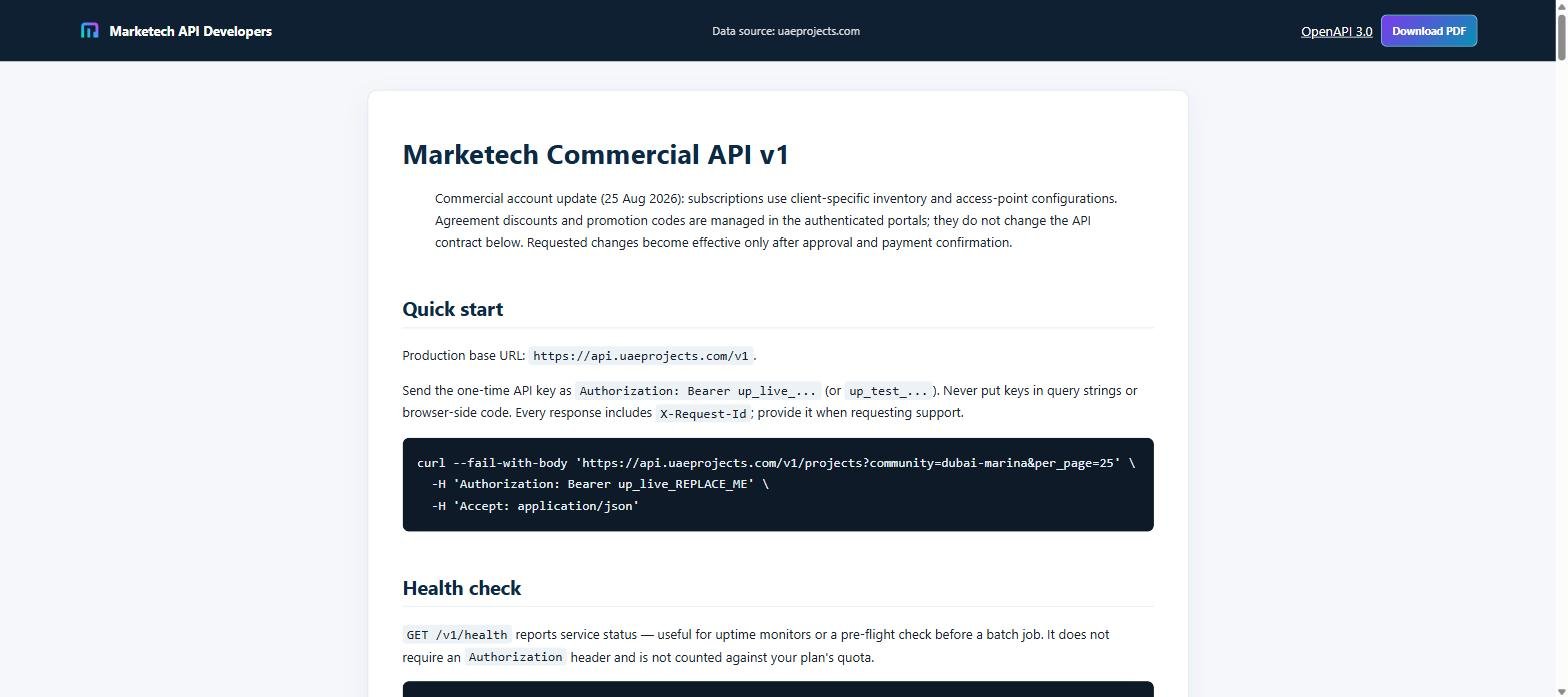
An endpoint becomes a commercial API only when access, documentation, limits and operational responsibility are designed together.
The public contract helps developers integrate. The management layer handles the less visible work: entitlements, quotas, subscriptions, usage and security oversight.
Beyond endpoints
The product boundary is larger than the REST route.
Developers need a stable base URL, authentication format, resource schema, errors and examples. Operators need to know which client can use which resources, how much usage is allowed and what happened when a request failed.
Treating those concerns as separate afterthoughts creates ambiguous contracts. Designing them as one system makes access predictable for both sides.
- 01Client application
- 02Key & scope checks
- 03Versioned resources
- 04Cache & quota policy
- 05Usage & security oversight
Entitlements
A key identifies access; scopes define its boundary.
Bearer keys answer who is making the request. Scopes answer what that client is entitled to request. Plans and subscriptions connect those permissions to the commercial agreement.
A useful developer contract states the required permission beside each endpoint instead of forcing the client to discover authorization rules through failed requests.
- Separate test and live access where the product supports both environments.
- Treat a key as a secret and keep it out of browser code and query strings.
- Return a request identifier so support can trace a failed request without collecting the payload in a public conversation.
- Make plan, scope and quota behavior visible before integration work begins.
Predictable delivery
Limits and caching are part of the contract.
Monthly quotas, daily controls and burst behavior protect capacity and make plans understandable. They should be documented as distinct cases rather than one generic rate-limit message.
Conditional requests reduce repeated delivery. The documented ETag flow allows a client to ask whether a representation changed and receive HTTP 304 when its cached version is still current.
GET /v1/projects HTTP/1.1
Host: api.uaeprojects.com
Authorization: Bearer YOUR_API_KEY
If-None-Match: "previous-etag"Operations
The operator layer makes the API manageable.
The verified staging console shows requests, active clients, response time, error rate, traffic, usage distribution, plans and subscription controls. Those screens are evidence of the management product, not production screenshots.
Client, key and security-event screens were intentionally excluded from public evidence because they contain contact details, key prefixes, identifiers or IP information.
| Developer-facing | Operator-facing |
|---|---|
| Authentication and examples | Key lifecycle and client access |
| Endpoint permissions | Plans, scopes and subscriptions |
| Limits and cache semantics | Usage, errors and response-time visibility |
| Request identifiers | Support and security investigation |
Technical notes
Show the security model without exposing security data.
Public documentation can explain safe integration patterns while live keys, signatures, nonces, client records and IP-bearing events remain private.
Progressive disclosureTechnical Notes
Signed enterprise requests
For enabled clients, timestamp, nonce and signature headers add replay-aware verification. Public examples use placeholders only.
Deterministic PDF caching
Documented brochure output uses a fingerprint of meaningful inputs so a relevant project, layout or agent change produces a new cached result.
Evidence boundary
The research pass verified public documentation and privacy-reviewed staging screens; it did not exercise an authenticated client endpoint.
Keep reading