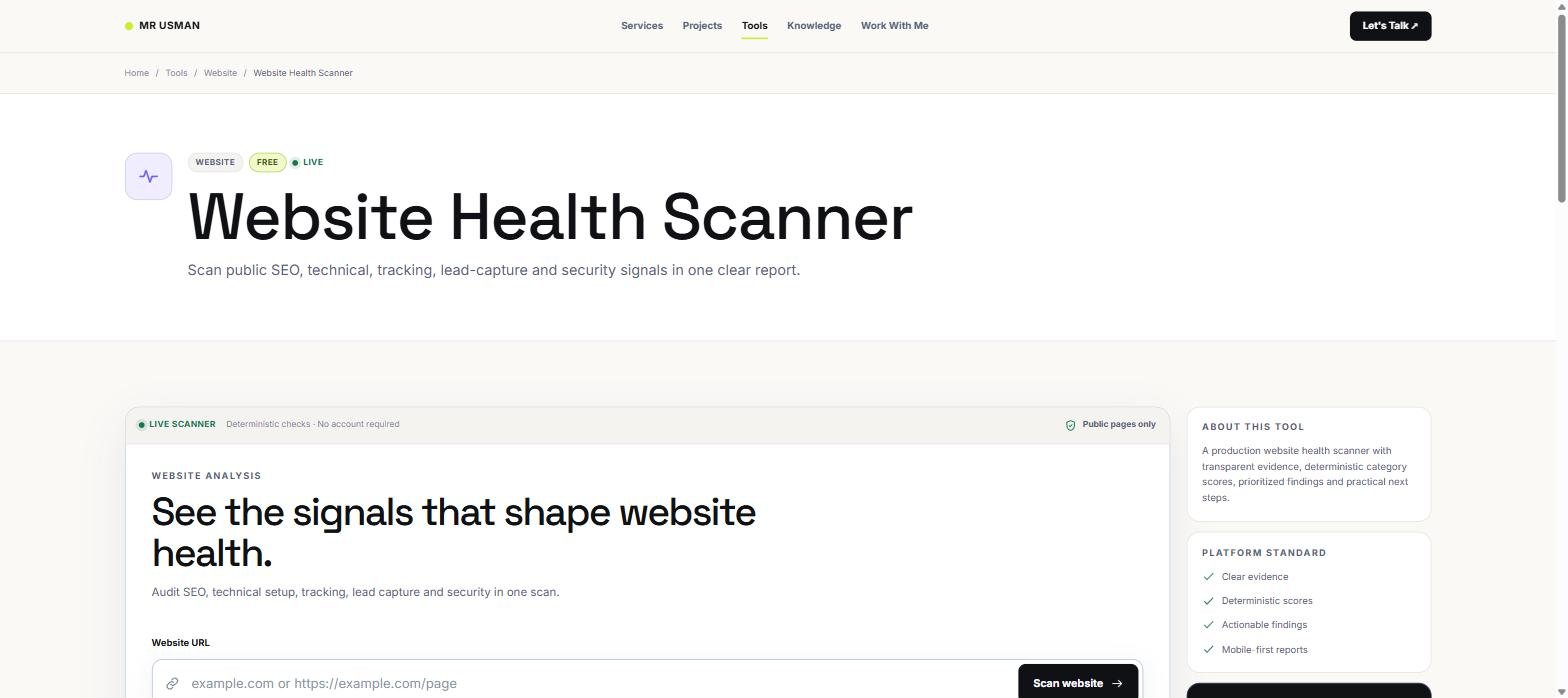
The fastest way to create an inconsistent tools directory is to build every tool as a separate miniature website. Input behavior, error states, evidence and reports drift immediately.
The MrUsman tools were released one at a time on a shared product foundation so each evidence model could remain specific while safety and interface patterns stayed consistent.
Release strategy
Build the platform one real tool at a time.
A foundation becomes useful when it survives a real product. Website Health came first, followed by SEO, DNS and email, tracking, and landing-page conversion readiness.
Each release added a purpose-specific analyzer while reusing the input, progress, error, report and deployment standards that had already been tested.
- 01Website Health
- 02SEO Audit
- 03DNS & Email
- 04GA4 / GTM
- 05Conversion Auditor
The five tools this article covers; each keeps its own evidence and scoring rules.
Security first
A public URL field is a network boundary.
A scanner should not trust a URL because it looks public. The destination, resolved address and every redirect need policy checks before the server fetches content.
Connection time, total time, redirect count and response size also need limits. Otherwise one public request can turn into unbounded server work.
- Accept only supported public HTTP and HTTPS destinations.
- Reject credentials embedded in a URL.
- Block private, reserved and local address space.
- Revalidate redirect destinations.
- Bound connection time, total time, redirects and response bytes.
- Return safe errors without exposing server internals.
Explainable results
A score should be reproducible from evidence.
The tools use explicit findings, severities and centralized weights. The same evidence model should produce the same score and next actions when run again under the same conditions.
That does not make every signal absolute. A static HTML response cannot prove JavaScript runtime behavior, provider-side delivery or the quality of a private analytics setup. The report must state that boundary.
Regression discipline
Every new tool expands the regression surface.
The shared foundation reduces repeated implementation, but it also means a common change can affect every tool. Releases therefore include both purpose-specific checks and a full-suite load regression.
- Exercise invalid, unsafe, timeout and oversized-response cases.
- Compare findings against known evidence for the tool category.
- Repeat inputs to confirm deterministic scoring behavior.
- Test input, progress, results, tabs and actions on mobile and desktop.
- Load all five production routes after deployment.
- Verify the shared Header/Footer contract remains consistent.
Progressive disclosureTechnical Notes
Short-lived reuse
Recent results may be cached briefly to reduce repeat network work without creating a permanent public scan-history product.
No AI scoring claim
Scores are derived from deterministic rules. AI is not presented as the source of the numerical result.
Limitations are evidence
A clear statement of what the scanner cannot observe is part of an accurate result, not a weakness to hide.
Keep reading